
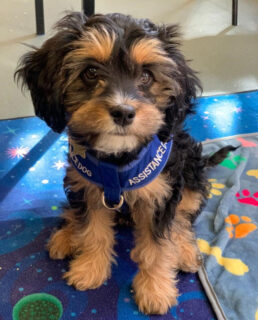
Children can benefit educationally and emotionally, increase their understanding of responsibility and develop empathy and nurturing skills through contact with a dog. In addition to these benefits, children take great enjoyment from interaction with a dog.
Is there a risk in bringing a dog into a school environment?
There is a risk, though there are a variety of accidents, which can happen within the school environment which far exceed the number of injuries or incidents caused by a dog. Therefore, it is just another risk that needs to be managed. A thorough risk assessment has been carried out and this is included in this document (see appendix). Dogs are not allowed anywhere on the school site at any time unless specifically authorised by the Head Teacher. This includes drop off and collection times. This policy outlines measures put in place to allow the school dog to be present.
School policy
- The dog will be owned by Mrs Ellis-Gage.
- The Governors have the right to refuse entry to the dog.
- The dog is a Cavapoo chosen because it is an intelligent breed that will respond well to training and which is known to be good with children, which sheds little hair and is very sociable and friendly.
- The Chair of Governors and the governing board agree that a school dog will benefit the children and staff at The Parkside School
- Staff, parents and children have been informed that the dog will be in school. Mrs Ellis-Gage, Headteacher has produced a risk assessment and this will be reviewed.
- Parents will be consulted on allowing their child to access the dog.
- Any people known to have allergic reactions to dogs must not go near the dog. All visitors will be informed that there is a dog in school.
- If the dog is ill she will not be allowed into school.
- The dog will be kept on a lead when moving between classrooms, it will be under the control and supervision of a trained adult.
- The school is being trained through Canine Assisted Learning for the first two years, this includes on-going training and support for the whole school.
- Children must never be left alone with the dog; there must be an appropriate adult present at all times.
- The trained adult must ensure that the dog does not feel threatened or overwhelmed by the children.
- Children should be reminded of what is appropriate behaviour around the dog. Children should remain calm around the dog. They should not make sudden movements and must never stare into a dog’s eyes as this could be threatening for the dog. Children should not put their face near a dog and should always approach it standing up.
- Children should never go near or disturb the dog that is sleeping or eating.
- Everyone must wait until the dog is sitting or lying down before touching or stroking him.
- If the dog is surrounded by a large number of children, the dog could become nervous and agitated. Therefore, the adult in charge of the dog must ensure that s/he monitors the situation. School Dog Policy
- Dogs express their feelings through their body language. Growling or bearing of teeth indicate that the dog is feeling angry or threatened. Flattened ears, tail lowered or between their legs, hiding behind their owner, whining or growling are signs that the dog is frightened or nervous. If the dog is displaying any of these warning signs he should be immediately removed from that particular situation or environment.
- Children must not be allowed to play roughly with the dog.
- Children should not eat near the dog.
- Children will be monitored when stroking the dog. They must stroke the dog’s body, chest or back – not by her face or head.
- Children should pay careful attention to hygiene, they must wash their hands immediately after stroking the dog.
- Any dog foul must be immediately disposed of.
- The office will know the whereabouts of the dog and notified of which staff will be supervising the dog.
- The fire evacuation procedure will include the dog.
- The dog can be off lead with pupils in enclosed areas such as the sensory playground, the main playground and football cage
- Pupil that have regular contact with the dog and that are in key stage 3 or above may walk the dog on the lead with an adult present. On the school grounds.
Reasons to have a dog in school:
In summary, academic research has shown that dogs working and helping in the school environment can achieve the following:-
- Improve academic achievement.
- Calming behaviours.
- Increase social skills and self-esteem.
- Increase confidence.
- Teach responsibility and respect to all life.
- Help prevent truancy.
- Motivate children who are often less attentive.
The following information has been taken from a range of sources to provide further detail about the benefits of having a dog in school:
Behaviour: In some schools, dogs are making a difference in the behaviour of pupils. Researchers report that students can identify with animals, and with empathy for the dog, can better understand how classmates may feel. Some schools are using dogs to improve behaviour problems by promoting positive behaviour in students.
Social Development: Dogs in school offer an opportunity for improving social development. They are especially useful for teaching students social skills and responsibility. Specifically, schools are using dogs to help older students build self-esteem; learn about positive and negative reinforcement, responsibility, and boundaries.
As a reward: Dogs will be gentle and loving, but at the same time full of fun and enjoyment for the students. Support Dogs can work with students on a one-one basis and will especially help those students who have been bullied, abused, going through upsetting/difficult times. Students who struggle with social interaction can find a reassuring friend in a dog.
School Dog Policy Roles and Responsibilities
The Governing Body has a responsibility to ensure that the school has a written policy for dogs in School.
The Head teacher is responsible for implementing this policy.
Teachers, staff, pupils, parents and visitors are required to abide by this policy.
Appendix General: The legal owner of the dog will be Mrs Ellis-Gage; she will bear the cost of purchasing the dog, training and ongoing care costs.